Scentless Soak
It’s for the sensitive types, but really it goes to show that you don’t need fragrance to get your woolens clean.
We are over-the-moon thrilled that our Malabrigo shipment arrived. All seventeen boxes! The store is well-stocked with Silky Merino, Organic Cotton, Lace, Worsted and Chunky weight Merino, as well as Aquarella and Gruesa.
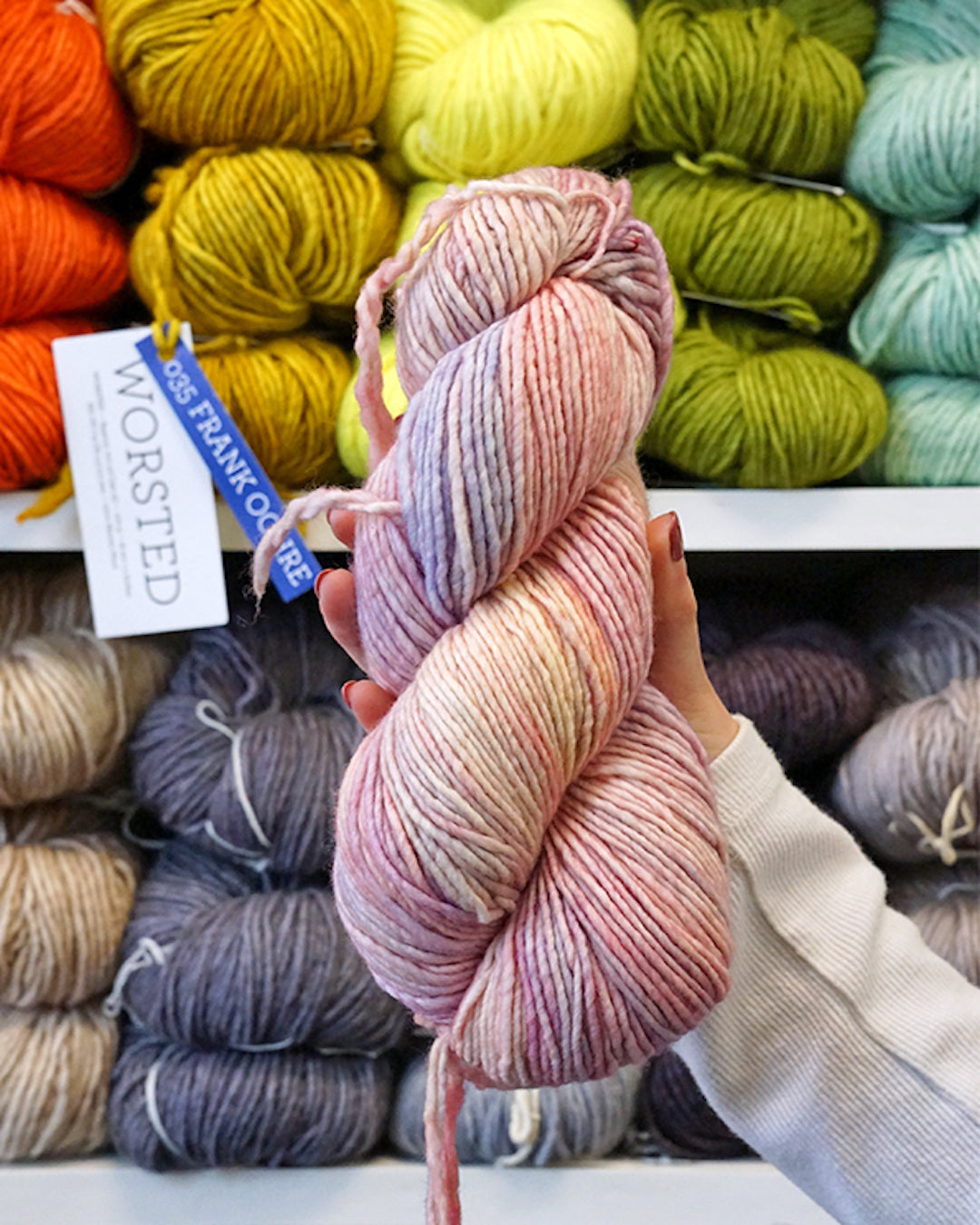
The skeins seem all the more precious after the fire at the Malabrigo Mill. Of course buying their yarn will help, but we wanted to do a little more, harness a little bit of that knitting philanthropy and sweeten the deal with prizes! We are holding a raffle for these three beauties:
Worsted in Ravelry Red
Worsted plied in Peach
Sock Yarn in Green-Ocher
To enter: Print and fill out the raffle-ticket.pdf
Make check payable to Malabrigo
Mail to: ImagiKnit 3897 18th St. San Francisco, CA 94114
All tickets must be postmarked before July 24th
We now carry the amazing Blue Face Aran from Fleece Artist, with the fingering weight to follow soon. These are mammoth skeins, 400 yards of beautiful hand painted Blue Face Leicester wool.
Customer Creations are regular feature on this site, but they are limited to the ones that wander back into the store or get taken out for a show and tell. Here we have some photos of lovely knitted gifts sent via email.
Christine sent photos of this stunning fuchsia shawl after we helped her track down some Jagger Spun. Can you believe this is her first lace project? The shawl is a birthday gift for her mother.
Monika made this sweet Baby Surprise Jacket using Debbi Bliss Cashmerino. This classic Elizabeth Zimmermann pattern has miters that make for interesting color change effects. The cuffs and picot crochet edging make a lovely addition, topped off with the sweet trio of buttons.
Babies aren’t the only lucky recipients of knitting love in Monika’s family. This is her nephew Ronan modelling another EZ classic, the Tomten jacket, knit using Karabella Aurora Melange.
If you have photos of finished projects made with yarn purchased from the store or projects that we’ve helped you with through classes or private lessons, please send them (medium-size: approximately 500×800 pixels, in jpeg format) to info at imagiknit dot com.
Casbah is the name of the sumptuous sock yarn from HandMaiden Fine Yarn. The fiber content sets it apart with 80% superwash merino, 10% cashmere and 10% nylon. Now I love the cashmere as much as the next knitter, but it was the color combinations that captivated. Unwinding the skeins to photograph was a visual treat. I had to know more. I was able to ask Jana Dempsey some questions about herself, her process and her yarn:
In the HandMaiden blog, you described yourself as “passionate” about fiber and knitting. Can you give me a short description of your life in fiber? Have you always been around yarn?
I basically grew up in a yarn shop. My Mother and Aunt started the company in the late 70’s. The Craftsman’s Art Supply and Fleece Artist were located in Historic Properties of Halifax, smack in the middle of the Nova Scotia College of Art and Design, so there were artists of all sorts around. But not just knitters - fashion designers, weavers, jewelery designers like my sister, who also works in the biz dyeing the Fleece Artist line. My Aunt now designs under her own label, Perl Grey. I did try to do other things, but surrounded by all of these artistic people, well some of it had to rub off.
Your yarns are stunning. The way the color travels and how much variation there is in even a single band of color. Each hank of yarn is one-of-a-kind, with colorways more like families or fraternal twins. What informs this push towards uniqueness? Is the freedom important to your artistic vision?
Well think of it like this: we cook, rather than bake. What I mean by that is that we develop a list of ingredients for a colour, but the exact quantities depend on so many variables we never exactly reproduce a colour. Nor would we want to. We’re artists and that would turn our studio into a factory. So like a chef, we mix with a pinch of this and a dash of that, we dye using water like a brush and wait for it to dry, like a canvas.
Tell me a little about your base fibers, these aren’t your everyday run of the mill (pun intended) sort. Your primary focus is on the luxury fiber side, but this also seems to extend to very unusual sources, the seaweed based seacell in your Sea Silk, being the most obvious.
The Hand Maiden line was always meant to be the luxury side of Fleece Artist. We just had so many yarns that we liked, we couldn’t really stop ourselves. But some of them were getting lost in the mix. Having a luxury label means that we can carry more yarn. Right now, we have over 50 yarns between the two lines. And with an unlimited colour range, we love all the options.
Thinking about the time it takes to make a garment, it seems to me that the quality of the yarn is incredibly important to the enjoyment of the knitting. After all, it make take a hundred of hour to complete a project so it is all the more pleasurable to use a fibre with a beautiful feel.
And cashmere for everything, even in socks? It is a decadent pleasure. Did you feel there was a hole in the market?
We just love knitting with Cashmere. There is nothing quite like it. Almost orgasmic really. I especially like knitting cashmere on a pair of Turbo’s. Ooooh.
I was reading another post in your blog about color inspiration, the idea of seeing colorways, from a butterfly to a Mark Rothko painting, is fascinating. The world seems to become your palette. Does everything become a potential colorway?
We’ve also used many paintings for inspirations like Monet and Cezanne, but most colourways are based on palettes from nature and the world around us. One of our dyers created a colour called “rusty car” or “rustico” based on a old wreck that was parked outside. Our best colours are often mistakes or experiments. Sometimes these become standard colourways, but often they are one-batch wonders never to be reproduced.
Piggy-backing on that last question, I’d imagine that dyeing is part art, part science. Which came first for you, or was the lure?
Art. The science is just a means to the end. We also love that just as we create something, it becomes full of possibilities all over again in the hands of knitters and weavers. Getting in photos of finished pieces often gives us goosebumps.
Thank you so much for taking the time to answer my questions and thank you for bringing such wonderful yarn to our needles.